Showing posts with label Sarawak Chief Minister. Show all posts

Saturday, November 1, 2014

Exposing Taib Mahmud, Sovereign of Sarawak

I’ve been pondering Tun Taib Mahmud’s penchant for the colour yellow.
Yesterday I learned that Taib likes his buildings painted yellow and always wears something yellow – even if it be but his underwear. Yellow was the colour of royalty in India. Yellow became and remains the colour of royalty in the Peninsula. Does Taib have pretensions to royalty?
I thought of royalty because I had read news reports that the Conference of Rulers met this week. I wondered if timber was on their meeting agenda.
I wondered about timber because when Dr Mahathir (now Tun) began his mission to clip the wings of the royals, he revealed long-withheld information about the royals’ thirst for a share in the timber resources of Malaysia. According to Professor Mark Gillen of the Faculty of Law of the University of Victoria in Canada, the royal thirst for timber concessions was made public on 15th and 18th December 1992 by the New Straits Times and The Star newspapers.
I wondered about timber because that has been the route to riches for Taib – as documented in the meticulously researched book Money Logging: On the Trail of the Asian Timber Mafia by Dr. Lukas Straumann, a professional historian and Executive Director of the Switzerland based Bruno Manser Fund.

Money is in the title for a reason.
Taib’s wealth is enormous. On the occasion of 77 year old Taib’s elevation from Chief Minister to Governor of Sarawak, The Diplomat wrote this about Taib’s wealth:
“Pak Uban or the ‘white haired uncle’ – and his family have amassed a fortune worth $20 billion or more, and established business tentacles through 400 companies into the tiniest reaches of the state and around the world that will ensure his clan continues to thrive long after his retirement on Friday.”
The Constitution of Malaysia grants to state governments – not the Federal government, not the Sultans – the authority over land and natural resources. Thus the Chief Minister (Menteri Besar), the head of the state government, has the power to determine how land will be used and by whom.
Taib became Chief Minister in 1981, the year Dr Mahathir became Prime Minister. Dr M had many enemies in Umno, in the peninsula. The last thing he needed was a rebellion by the Sarawakians, the “fixed deposit” which kept him in office. Taib turned Mahathir’s insecurity to his advantage.
For a fee, Taib delivered the ‘Sarawak stability’ Mahathir needed. His fee was to reign unchecked, like an old-time royal.
A hallmark of Taib’s reign was his abolishment, in 1985, of the forestry ministry. He replaced it with the ministry of resources planning and appointed himself its head. This gave him the sole prerogative to grant concessions and plantation licenses.
Dr Straumann points out the result of Taib’s manoeuvre: “Exploitation of all of Sarawak – worth billions of dollars – depended on just one person, with no checks and balances, no transparency and no public accountability.” (Page 119)
As I said earlier, it is public knowledge that Taib and his family are worth USD 20 billion or more. Dr Straussman goes further: he names the companies which are the vessels of Taib’s wealth.
The first to appear in his list is Sakto real estate company (Canada, 1983) incorporated two years after Taib became Chief Minister; next is Sakti real estate company (California, 1987); then the reverse takeover of state construction company, Cahaya Mata Sarawak (1993); then Ridgeford Properties (London, 1996); then purchase of RHB bank, Malaysia’s fourth largest bank (2001).
The list and its webs and intrigues are long. Suffice to say that by 2011 “The Taib family had a financial interest in over 400 companies in 25 countries and offshore financial centres.” (Page 303)
The book reads like a thriller. Few readers will detect that it’s a translation of a work first published in German. I hope the publishers are working on a Malay translation.
The Federal government and the State legislature allowed Taib to act like a sovereign. He rewarded those who supported him. He punished those who did not. There are hordes of examples in the book. I’ll just mention one.
Taib turned against his Uncle Rahman Ya’kub, who had brought him into politics and had stepped into the role of Governor to make way for him. The extent of Taib’s vindictive agenda was displayed for all as an example of what would happen to anyone who would resist this Adelaide University trained lawyer.
This quote shows the climate of fear Taib created; it also exhibits Dr Straumann’s readable style:
“Taib was “aggrieved and hell-bent on taking revenge, and everyone has been particularly afraid of him since that time,” reports one of Rahman’s former golf partners. “Whenever Rahman appeared on the golf course in Miri, suddenly there was not a soul left to be seen there. Nobody wanted to be spotted by Taib’s spies on the golf course at the same time as Rahman.” Any business people who had had dealings with Rahman lost their public contracts and were shut out of lucrative deals. Politicians and civil servants suspected of supporting Taib’s uncle were side-lined. “In those days, I used to play golf with Rahman frequently, but in the end I had to stop. My son asked me to; he was afraid of losing his government job.”” (Page 121)
Money Logging is not only meticulously researched; it is thoughtful and comprehensive. It discusses the ridiculous projects spawned to consume the electricity to be generated by Taib’s dams. It describes the injustices done to the natives. It exposes many who contributed to Taib’s “success.”
Even the FBI of the USA and ministries of the Canadian government are implicated, as are banks and countries such as Hong Kong and China. Money Logging is as insightful and explosive a book as Malaysian Maverick: Mahathir Mohamad in Turbulent Times by Barry Wain.
The Rulers Conference is attended by the Rulers together with their Chief Ministers. I wonder if the man in yellow from Sarawak attended. I wonder what the Rulers and Chief Ministers think of Taib Mahmud. I hear Michael Douglas saying “Greed is good” and Edmund Burke saying “The only thing necessary for the triumph of evil is for good men to do nothing.” Who will prevail?
 
Source: http://write2rest.blogspot.com/2014/11/exposing-taib-mahmud-sovereign-of.html

Sunday, June 24, 2012

Najib’s Deadly Words Threaten Disaster For Musa Aman!


Posted Saturday, June 23rd, 2012

Musa denied "any business relationship with an individual named Michael Chia"
Make no mistake, the authors of written parliamentary answers in response to awkward questions choose their words with utmost care.

MP Chua Tian Chang had enquired of the Prime Minister what had happened to the Anti-Corruption Commission investigation into major money-laundering by the Sabah resident Michael Chia, who is a known side-kick of the Chief Minister, Musa Aman.
Musa Aman has been busy repeating over past weeks that he has nothing to do with Chia and that to suggest otherwise was to defame him.
So consider the wording of this answer given by the Prime Minister:
“The Malaysian Anti-Corruption Commission has conducted investigations into the Michael Chia case which is linked to the Sabah chief minister.  
It has been completed and presented to the AGC for study and a decision”           [Najib Razak, written answer21/6/12]

 “Linked to the Sabah chief minister”
In one stroke the Prime Minister has cut the ground from beneath the already shaky CM.
Musa’s feeble pretences of “not entertaining frivolous allegations” and protests against “defamation” are now collapsed entirely through the words of his own boss, who has acknowledged in the most public way possible that the Michael Chia money-laundering case “is linked to the Sabah Chief Minister”.
What are we now to make of Musa’s recent statement?:
“I deny all these allegations. I wish to put it on record once again that I have no business association whatsoever with an individual named Michael Chia,”
Well it seems that Malaysians now have to choose whether to believe the Chief Minister or the Prime Minister!

Why not resign?
With such a public demonstration of disownership from his own boss, it is baffling how Musa Aman has reasoned it possible to remain in his office for the remainder of the week.
Apparently he has yet to comment on this confirmation that he is indeed linked to the investigation into the laundering of around a hundred million dollars of timber kickbacks.
Significantly, he has not dared this time to come out and deny the allegation made by his own Prime Minister, whereas he had been happy to accuse Sarawak Report of reproducing forged documents!
And, of course, Najib Razak has not been alone in choosing words that finger Musa.
A similar deliberate and damning statement has already been issued by authorities in Switzerland, who were approached by Hong Kong’s investigators over Musa’s Zurich bank account, where the timber money trail has been clearly ending up.
The careful answer by the Swiss Attorney General’s office to the question by a journalist again implicated Musa:
Question: “The Malaysian politician Musa Aman, Minister of the State of Sabah, is at the centre of a corruption case in Malaysia and Hong Kong. Hong Kong’s anti corruption authority has compiled a report on the case. It is alleged that, through nominees, Aman has received a total of 90 million US dollars of corruption payments from logging companies in return for granting logging concessions. Allegedly, these funds have been laundered through a network of companies and deposited on UBS accounts in Hong Kong and Zurich. Lawyer Richard Christopher Barnes and businessman Chia Tien Foh have been mentioned as nominees. These occurrences date back to the years 2006 to 2008.                                                                              My question is the following one: Has the Office of the Attorney General led an investigation for suspected money-laundering or other criminal offences in this context?“ [
Answer: “The Office of the Attorney General has in this context provided legal assistance".
That simple answer clearly acknowledges that Musa Aman was at the centre of the affair, as laid out in the question!
Who else is implicated among BN's governing elite?
It might be observed that if Najib dismissed every corrupted member of the BN government there would be few left to govern.  This is, of course, why the people need to perform this task at the next election.
However, with Musa squarely singled out by this case, the Attorney General (Abdul Gani Patail) is looking particularly vulnerable also. It has long been known that the Malaysian Anti-Corruption Commission (MACC)  completed its enquiries many moons ago and sent a hefty list of suggested charges up to the AG’s office, where all progress has subsequently been blocked.
The AG is a relative of Aman.  He is also enmeshed in numerous other corruption controversies.  His third class law degree does not lend lustre to his position.
So, again, Najib’s choice of words puts pressure on him.  The PM has left the ball firmly in the AG’s court.  If he continues to resist a prosecution, despite the glaring public evidence that prove there is a case for the Sabah CM to answer, then the fault for that will clearly rest with him.
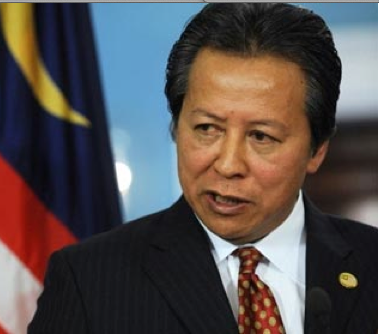
And there is another high placed politician who is also weakened.  Musa’s brother is the Foreign Minister, Anifah Aman and Sarawak Report has already demonstrated how he too has benefitted from the handing out of timber licences by his own brother.

Hanging out to dry

Next in line to face the heat? Foreign Minister Anifah Aman benefitted from logging concessions handed out by his brother.


The stupidity with which Aman has plundered Sabah’s remaining forests and then tried to hide the proceeda has been staggering.Najib has certainly left some very senior people with some serious embarrassment and potentially far worse after his decision to say what he did.  It may be that this is because he too feels angry and exposed.
Now the Swiss authorities are faced with investigating the role of their bank UBS AG in the whole unsavoury process, there remains little left to hide.
But, what of the biggest crook of all, the Chief Minister next door, who has spent the last 30 years confiscating native lands and handing them to his family and nominees?  Who has chopped down vast tracks of pristine jungle and profited from the kickbacks and handed billions in state contracts to companies owned by his family and political clients?
It is time that a question was likewise asked about the glaring evidence of Sarawak’s utter destruction through corruption and why nothing has been said of the MACC investigation against him either – or has Attorney General Abdul Gani Patail blocked that too?
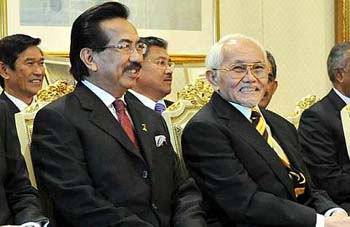
Two Chief Ministers who have made billions destroying
the Borneo Rainforest and stealing from the native people


Source: http://www.sarawakreport.org/2012/06/najibs-deadly-words-threaten-disaster-for-musa-aman/